Albemarle County Service Authority: what’s in your tap water?
Albemarle County Service Authority serves 71,078 people from Rivanna River system (RWSA). The numbers below
are from the utility’s own published testing, compiled by the EWG Tap Water
Database (June 2026). The water is legal, the question is how it
compares to health guidelines, which sit well below the legal limits.
Reviewed by Tyler Griffin, Founder, SwiftPro Heating, Cooling & Plumbing
Each card shows how far a contaminant sits above its health
guideline, the level scientists consider protective over a lifetime of
drinking. A system can pass every legal test and still carry these levels.
Each bar starts at the health guideline and runs on a log scale, the faint ticks mark 10× and 100× over; the dark notch is the legal limit where one exists.
Health-effect labels and guideline levels above come from the
EWG Tap Water Database
(June 2026), advisory benchmarks set by EWG’s researchers
(methodology),
not legal standards. The utility’s water meets federal legal limits.
× 289
What does 289× actually mean?
Think per glass: at 289× the guideline, one glass of tap water
carries what 289 glasses would hold at the health-guideline level. The top
flag here is Haloacetic acids (HAA9). Not an emergency, but worth knowing,
because the fix is specific and usually simpler than people expect.
ZIP codes served by Albemarle County Service Authority include 22901, 22904, 22905, 22909, 22910, 22911, 22923, 22924, 22931, 22932, 22936, 22937, 22940, 22942 and 14 more. Type yours on the free report page to see the version for your address.
Every system we track, plotted by Water Score, 0 to 100,
higher is safer.
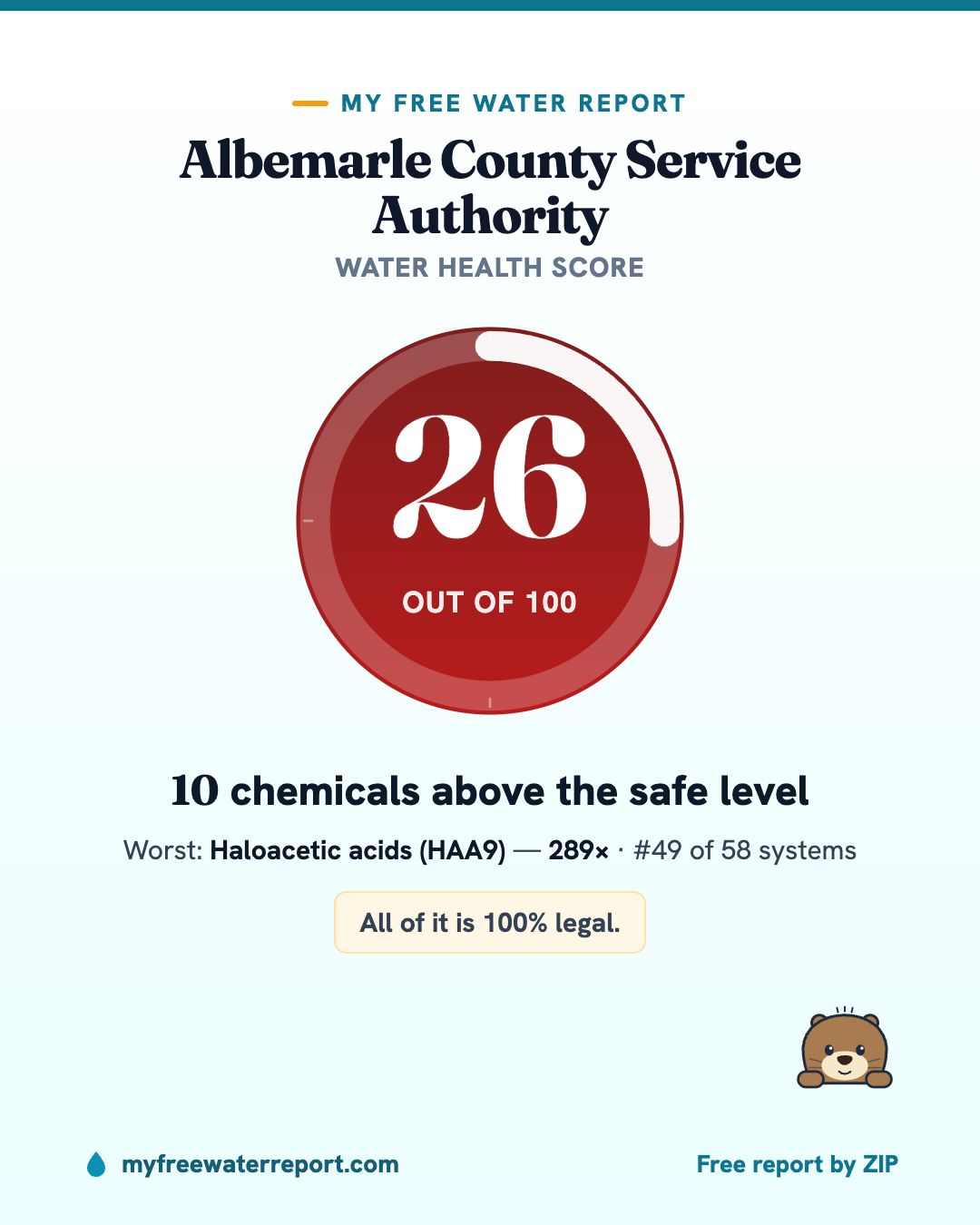
Albemarle County Service Authority scores 26/100, ranking #10 of 58 tracked systems.
What actually fixes it
No single filter does everything, each option covers
different flags, so the right answer depends on what’s in your water and
how your house is set up. You’re weighing options, not grades of good.
Pitcher / carbon
Good on chlorine taste and some
disinfection byproducts. Cartridges fade fast, about every 2 months.
Type your ZIP, get the full picture free: every flag, what it means per
glass, and which fix covers it. If you’d rather have a person look at it
with you, the free in-home Home Water Checkup tests what no city report can
see, your heater, pressure, and hardness.
 Grab the postable Water Score card →