
How hard is your water?
Each utility publishes its hardness once a year. Here is what they reported, with the towns each one serves. Anything over 3.5 grains per gallon is enough to leave sediment in a tank.
| Utility | Hardness | What that is | Towns |
|---|---|---|---|
| Arlington County (Washington Aqueduct water) | 8.3 grains per gallon 2025 | Hard | Arlington |
| City of Manassas Utilities | 2.7 grains per gallon 2025 | Soft | Manassas |
| Fairfax Water | 3 to 10.8 grains per gallon 2025 | Soft to very hard | Annandale, Burke, Centreville, Chantilly, Dunn Loring, Fairfax, Fairfax Station, Lorton, Oakton, Reston, Springfield |
| Fairfax Water (Washington Aqueduct water) | 5.6 to 10.9 grains per gallon 2025 | Moderately hard to very hard | Falls Church, McLean |
| Loudoun Water | 4.1 to 10.8 grains per gallon 2025, at its supplier | Moderately hard to very hard | Ashburn, Sterling |
| Prince William Water | 2.6 to 10.5 grains per gallon 2025 | Soft to hard | Bristow, Gainesville, Woodbridge |
| Town of Herndon (Fairfax Water's water) | 4.1 to 10.8 grains per gallon 2025 | Moderately hard to very hard | Herndon |
| Town of Leesburg Utilities | 5.8 to 8.8 grains per gallon 2025 | Moderately hard to hard | Leesburg |
| Town of Vienna (Fairfax Water and Washington Aqueduct water) | 5 to 10 grains per gallon 2024 | Moderately hard to hard | Vienna |
| Virginia American Water | 4.6 to 11.2 grains per gallon 2025 | Moderately hard to very hard | Alexandria |
Hardness classes from the U.S. Geological Survey. Loudoun Water prints no hardness figure; its towns show Fairfax Water's Potomac plant, where its water quality page points. On a private well, none of these numbers are yours: a test at your tap is the one that counts.
Signs your water heater needs a flush
- Popping or rumbling while it heats. That is water boiling under a layer of sediment.
- Grit in the faucet screens on the hot side.
- A drain valve nobody has opened since the house was sold.
- Hot water that never gets as hot as it used to, or goes cold and stays cold
- Less flow at the hot taps than there used to be
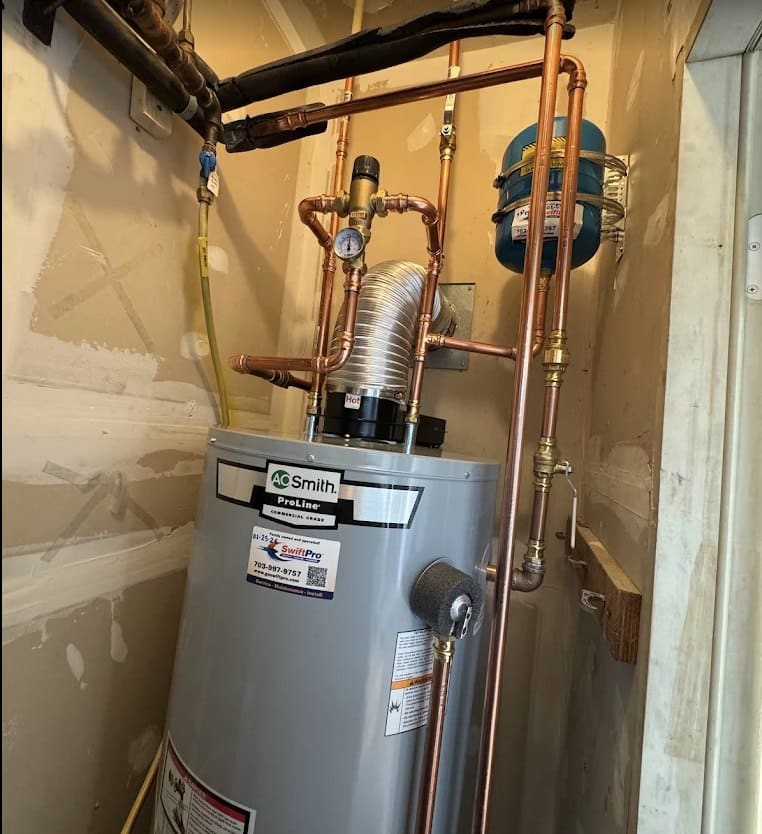
How to flush a tank water heater yourself
- Turn the water heater off: gas to its vacation or pilot setting, or switch off the breaker on an electric one.
- Close the cold water valve on the pipe going into the top of the tank.
- Run a garden hose from the drain valve near the bottom to a floor drain, a laundry standpipe or outside. The water comes out hot.
- Open a hot water tap upstairs so air can get in, then open the drain valve and let the tank empty.
- Open the cold valve for a few seconds at a time to stir up what's left, until the hose runs clear.
- Close the drain valve, take off the hose, and refill with the upstairs hot tap still open until it runs steady.
- Only then turn the gas back up or the breaker back on. An electric heater switched on before the tank is full burns out its elements.
The catch is the drain valve. On a lot of tanks it's plastic, and grit can keep it from closing again. If your tank is ten years old or more and has never been flushed, have it looked at first.
What the $99 flush includes
Our own plumbers do it, any brand, and the plumbing safety check comes with it (normally $149).
- Tank drained and flushed, so the sediment comes off the bottom
- Anode rod checked, the part that corrodes so the tank does not
- Temperature and pressure relief valve tested
- Thermostat setting and venting checked
- A straight answer on where the tank is in its life
- Supply lines: washing machine hoses and fixture supplies, the cheap parts that flood basements
- Shutoff valves: the main and the fixture shutoffs, and whether they actually turn
- Water pressure: a reading at the tap. High pressure strains every fixture in the house.
- Drains and leaks: visible corrosion, how the drains run, and anything running when it should not be
- Toilets and traps: running toilets, loose traps and slow drips under the sinks
More on the visit itself on SwiftPro's water heater flush page, and on keeping a water heater going in water heater maintenance in Northern Virginia.

Tankless? Descale it instead
A tankless water heater doesn't hold water, so there's nothing to drain. Hard water leaves scale inside its heat exchanger instead, and the fix is descaling: $300 at SwiftPro, regularly $350. Navien's manual calls for it once a year wherever the water runs 4 grains per gallon or harder with no softener. The tankless descaling guide covers how often, the codes that mean scale, and doing it yourself.
What the makers say
Every maker's manual asks for it, and several warranties don't cover damage from sediment or scale.
| Brand | Type | Their manual |
|---|---|---|
| A. O. Smith | Tank | Drain and flush at least once a year, more often if needed. Its manual warns that skipping it can damage the tank and the drain valve and cause leaks. Manual |
| Rheem | Tank | Once a year for most homes, every six months on hard water. Rheem says sediment acts like insulation on the bottom of the tank, so it runs longer, uses more energy and wears out faster. Manual |
| Bradford White | Tank | Drain off a gallon every month to clear silt and sediment, and have a technician go over the heater at least once a year. Manual |
| State | Tank | Drain and flush, and pull the anode rod to look at it, at least once a year. Its manual says draining the sediment extends the life of the tank. Manual |
| Navien | Tankless | A flush once a year wherever the water runs 4 grains per gallon or harder with no softener on the line, which is nearly all of Northern Virginia. Manual |
| Rinnai | Tankless | Once a year in a home wherever the water runs 4 grains per gallon or harder, and its manual says skipping the flush will damage the heat exchanger. An LC code on the display means it is scaling up and must be flushed. Manual |
| Noritz | Tankless | Once a year from 3 grains per gallon up with no softener. Its C1 code is a descaling reminder, and Noritz will not cover the damage if the reminder came up and nobody flushed it. Manual |
| Rheem | Tankless | Flush the heat exchanger once a year, the manual says, or risk higher running costs and early failure. An A01L code on the display means lime has built up inside. Manual |
| Takagi | Tankless | Its standard warranty does not cover damage from water harder than 7 grains per gallon in a single-family home (X3 models are the exception). Every utility on the chart below tops 7 at some point in the year except the City of Manassas. Manual |
Your town's water and your water heater
A page for each town: how hard its water is, who supplies it, how old its homes are, and what that means for a water heater.
Questions people ask
How often should you flush a water heater?
How much does a water heater flush cost in Northern Virginia?
What happens if you never flush a water heater?
Should I flush a water heater that's 10 years old and never been flushed?
Can I flush my water heater myself?
Does a water softener mean I don't need to flush?
Get it flushed for $99.
Normally $199, with the plumbing safety check included. Tankless descaling is $300, regularly $350. Pick a time online, and you pay after the visit.